
Notes on this page
Chapter 12, Page 26
Summary
At Karnak, Dr. Manhattan leaves the devastated pool chamber, passes silently through Veidt’s geometrically ordered rooms, and approaches Adrian from behind. After six wordless panels, Veidt greets “Jon” without turning and calmly requests a conversation, shifting the scene from physical aftermath to moral confrontation.
Panels
Six narrow panels occupy two rows before a full-width reveal. The silent sequence moves from Manhattan’s dripping foot to his floating body, a distant corridor view, and increasingly obstructive close framings of his legs; these measured visual steps make his approach feel both effortless and inexorable. Panel 7 releases that compression theatrically, revealing Veidt already waiting, while the following page converts the suspense into philosophical debate.
Environment
Karnak appears less like a home than a ceremonial machine: monumental columns, stark corridors, Egyptian-style rugs, and the star-map ceiling lead toward Veidt enthroned before his glass orrery. The opulence and severe symmetry embody his self-fashioned identity as philosopher-king, while Manhattan’s unannounced passage demonstrates how little such architecture can obstruct genuine power.
Color
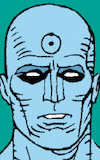
Cool blue makes Manhattan the page’s visual constant as he crosses lavender, pink, and black interiors; his body reads as a calm, almost diagrammatic intrusion into Veidt’s ornate domain. The final panel abruptly intensifies the palette with orange, purple, and yellow, yet the pale globe in the foreground partially eclipses both men, subordinating their confrontation to the planetary stakes of their argument.
Symbols
Circles organize the page: ceiling lights become stars, then constellations, then the immense transparent orrery dominating panel 7. Its miniature planets give visible form to Veidt’s desire to comprehend and arrange the world as a closed system; Manhattan’s arrival behind it quietly introduces a power—and a moral judgment—that cannot be contained within Adrian’s model.
Themes
The page stages a revealing contest between two kinds of power. Manhattan can ignore gravity, walls, and ordinary human scale, yet Veidt controls the encounter socially: seated, composed, and facing away, he announces that he expected Jon. That poised greeting is both confidence and performance, preparing the next page’s conflict between Veidt’s utilitarian self-justification and Manhattan’s estrangement from human affairs.
Graphic Novel Technique
The page makes duration through repetition rather than dialogue: the reader must traverse each silent fragment of Manhattan’s movement before receiving Veidt’s greeting. The gutters turn an instantaneous superhuman journey into a deliberate procession, while the enlarging partial views withhold the destination like cinematic suspense. Unlike film, however, the entire patterned approach and its concluding tableau remain simultaneously visible, allowing the page’s geometric inevitability to be apprehended at once.