


Notes on this page
Chapter 12, Page 25
Summary
Dr. Manhattan walks alone through Veidt’s Antarctic refuge while television reports announce that the supposed alien catastrophe has ended the immediate threat of nuclear war. He passes two dead, embracing bodies, absorbs the human cost of Veidt’s plan, and crosses the vast reflecting chamber toward a final confrontation with Adrian.
Panels
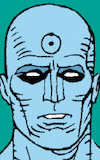
Six panels expand the nine-panel grid: three narrow establishing panels give way to a two-thirds-width view of the bodies, a close-up of Manhattan, and a full-width long shot. This progressive enlargement slows his walk into contemplation. The previous page’s explosive killing of Rorschach is followed by near-stillness; the next page prolongs the silent movement before revealing Adrian, making the page turn a restrained confrontation rather than an action climax.
Environment
The bank of television screens turns Karnak into a remote observation post for global history: broadcasters describe Russia offering aid, war being averted, and millions dead. The damaged equipment and dead attendants puncture that reassuring media narrative, showing how Veidt’s immaculate private institution conceals violence even while publicly producing an image of salvation.
Color
John Higgins bathes Karnak in pinks, lavenders, pale greens, and cream, with deep black carving out screens, floors, and empty space. Manhattan’s cool blue remains visually distinct but no longer dominant; surrounded by Veidt’s artificial pastel luxury, he appears isolated and mournful. The flooded floor turns the palette liquid, making the apparently ordered interior look unstable.
Symbols
Reflection is the page’s governing motif. In the final panel, Manhattan walks through a shallow pool that breaks architecture and body into wavering doubles, fitting a chapter concerned with unstable moral judgments and competing versions of reality. His exposed forehead symbol resembles an unblinking eye, yet his downcast expression makes near-omniscience look less like mastery than sorrowful witness.
Themes
The page compresses Watchmen’s central utilitarian problem into one cruel juxtaposition: public voices celebrate peace while Manhattan silently confronts particular corpses. Veidt’s reasoning counts lives statistically—millions dead against billions saved—but the images restore physical intimacy to those numbers. The embracing bodies insist that sacrifice is experienced by individuals, not by the abstractions through which power justifies itself.
Graphic Novel Technique
Comics allows the television commentary to continue across separate spaces while the reader simultaneously studies Manhattan’s wordless passage through Karnak. The balloons promise geopolitical relief above images of wreckage and death, creating an irony neither prose narration nor a rapidly edited film would sustain in quite the same way. Readers can pause over the bodies even as the official story presses forward toward closure.