



Notes on this page
Chapter 12, Page 17
Summary
In Veidt’s Antarctic retreat, Ozymandias lectures Rorschach, Nite Owl, and Silk Spectre on the supposed triumph of his plan and turns toward his screens for confirmation. His self-congratulation is abruptly interrupted when Dr. Manhattan—whom Veidt believed destroyed—reappears at colossal scale and smashes into the chamber, instantly reversing the balance of power.
Panels
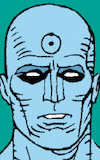
Three conventional panels sustain Veidt’s measured speech before the lower page breaks into two tall images: a narrow revelation of Manhattan and a vast impact panel. Panel 4 pauses time for recognition; panel 5 releases that tension as debris, diagonal motion, and Veidt’s cry overwhelm his rhetoric. The enlargement is the formal reversal: Veidt dominates the conversation above, but Manhattan dominates the page below. The following page extends the joke and threat by showing Veidt literally crawling beneath Manhattan’s feet.
Environment
Veidt’s sleek technological sanctuary becomes materially fragile: its enormous window first frames Manhattan like an impossible apparition, then its wall and equipment explode into rubble. The retreat was designed as a command center from which Veidt could observe and manage history, but Manhattan’s entrance exposes that architecture of control as merely another breakable enclosure.
Color
The upper row’s subdued lavenders, greens, and yellow light keeps Veidt’s performance cool and controlled. Below, deep black makes Manhattan’s luminous cyan body startlingly absolute, while Veidt’s yellow-edged purple silhouette appears almost negligible. The final panel replaces polished order with pale green rubble and scattered black voids, giving the disruption a harsh graphic clarity.
Symbols
The central motif is scale. In panel 4, Veidt is reduced to a tiny, brightly outlined figure before Manhattan’s immense blue body; in panel 5, Manhattan’s hand alone dwarfs Veidt and the other costumed figures. This disproportion turns power into something immediately visible and punctures Ozymandias’s preferred image of himself as history’s supreme mover.
Themes
Veidt claims that humanity’s failure proves his success and presents mass murder as an enlightened form of heroism; the page answers him through dramatic irony. His sentence about turning toward proof of triumph collapses into “uh,” as the man he failed to kill returns. The interruption does not yet refute Veidt’s utilitarian argument, but it destroys his assumption that superior calculation grants complete control over events—or exemption from judgment.
Graphic Novel Technique
The page makes Veidt’s verbal collapse inseparable from its spatial design: a speech balloon trails from one top panel to the next, then falters precisely as the reader’s eye descends toward Manhattan. Because comics allow the lower revelation to remain visible while the earlier boasting is reread, triumph and refutation coexist on the page. That coordination of dialogue, scale, grid disruption, and reader-controlled timing is a particularly sophisticated use of mainstream superhero-comics form.