



Notes on this page
Chapter 12, Page 13
Summary
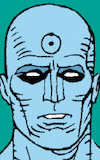
Inside Karnak, Dr. Manhattan searches for Veidt, recognizes that the tachyon interference has been an elaborate lure, and follows Bubastis through an intrinsic-field-subtractor chamber. Meanwhile, Laurie approaches the building from outside, unaware that Veidt is drawing Manhattan into a trap whose consequences arrive on the following page.
Panels
Five panels expand the nine-panel grid into three broad tiers: a panoramic establishing shot, three narrow pursuit panels, and another panorama outside. The middle row slows Manhattan’s advance into measured stages while the top panel’s deep recession makes him small within Veidt’s machinery. The final cut to Laurie suspends the trap at its threshold, so turning the page releases the violence prepared here.
Environment
Karnak’s interior resembles an immense technological underworld: flooded-looking floors, pipes, turbines, hazard stripes, a radiation warning, and instructions for the intrinsic field subtractor. Veidt’s elegant Antarctic retreat thus reveals its industrial core, where pristine futurism depends upon dangerous machinery; Laurie’s solitary approach through deep snow emphasizes how thoroughly the landscape isolates this private center of power.
Color
Cold cyan identifies Manhattan against gray-blue machinery, while lavender pipes and shadows make Karnak feel simultaneously clinical and uncanny. Sharp yellow accents—warning stripes, illuminated windows, and the glowing entrance—guide the eye toward danger. In the final panel, Laurie’s purple figure stands against snow and yellow light, visually linking her to the interior plot while keeping her physically separated from it.
Symbols
Glass is the page’s central motif. Manhattan threatens to turn Veidt’s refuge into glass, imagining matter as transparent and controllable, yet he cannot see through Veidt’s deception; the building’s bright windows and rounded entrance likewise present inviting surfaces that conceal lethal mechanisms. Bubastis becomes another living instrument in Veidt’s design, foreshadowing the sacrifice made explicit after the page turn.
Themes
The page reverses the apparent balance of power. Manhattan can threaten to transform the entire structure, but Veidt controls information, timing, and the route Manhattan follows; near-omnipotence is rendered vulnerable through manipulated knowledge. The trap also condenses Veidt’s utilitarian logic: Bubastis, despite being his companion, is positioned as expendable material in a plan whose full brutality Manhattan has not yet grasped.
Graphic Novel Technique
Comics allows the reader to hold Manhattan’s descent and Laurie’s approach on the same page without claiming they occur at precisely the same instant. The repeated horizontal snow bands in the final panel partially obscure Laurie and the building, echoing the concealment operating inside. Most importantly, the page turn becomes Veidt’s weapon: the reader must voluntarily cross the gutter to activate the trap’s visual payoff.