



Notes on this page
Chapter 12, Page 12
Summary
Inside Veidt’s Antarctic retreat, Rorschach and Nite Owl pursue Adrian Veidt while Dr. Manhattan materializes among them, repeating remarks displaced from the preceding page by tachyon interference. Veidt immediately tests Manhattan’s awareness by asking about Laurie; the final panel answers visually, cutting outside to her solitary approach through the snow.
Panels
The page uses five panels built from the nine-panel grid: three narrow panels above two broad horizontal tiers. The crowded top row accelerates pursuit and confusion, while panel 4 expands the confrontation into a tableau whose separated figures barely communicate; panel 5 then pulls back still farther, converting Veidt’s question about Laurie into a quiet visual answer. That downward progression from cramped interiors to an exposed long shot drains urgency into ominous stillness.
Environment
Karnak’s interior is less a home than a technological stronghold: dark doorways, severe steps, banks of pale screens, and Veidt’s genetically engineered lynx, Bubastis, make private wealth resemble sovereign power. The last panel reverses that controlled enclosure, placing Laurie amid damaged lamps, debris, and immense drifts—a small human figure exposed to the Antarctic landscape.
Color
Cold blue binds Manhattan to the snow outside, visually connecting the fortress confrontation with Laurie’s isolation even before the narrative reunites them. Against this chill, Veidt’s purples and the restrained yellow accents mark his surroundings as carefully designed; Laurie’s small patch of yellow in the final panel makes her readable at a distance but also emphasizes how vulnerable she is within the blue-white expanse.
Symbols
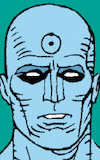
Doorways dominate the page, repeatedly framing Manhattan as he enters or withdraws; they turn his apparent freedom of movement into a visual pattern of uncertain arrival. The masked Rorschach and Nite Owl flank his unmasked blue body in panel 3, sharpening the book’s contrast between performed identities and Manhattan’s increasingly impersonal, almost abstract presence.
Themes
The page turns Manhattan’s near-omniscience into a temporary disability: tachyons have made time unreliable for the character who normally experiences it all at once. Veidt exploits that confusion with unnerving composure, redirecting the supposedly godlike figure toward Laurie while the human pursuers misread him as drugged. Power here belongs not simply to the strongest person, but to whoever controls information, timing, and the conditions under which others perceive events.
Graphic Novel Technique
Comics can place Manhattan’s temporal confusion before the reader without reproducing it as continuous spectacle: dialogue from the previous page recurs in a new spatial context, so identical words acquire a belated explanation. The reader may look backward, compare panels, and experience time as a designed page pattern. The final cut to Laurie likewise makes Veidt’s spoken question and its visual answer coexist on the page—an especially sophisticated use of juxtaposition for mainstream superhero comics of the period.