



Notes on this page
Chapter 12, Page 11
Summary
At Karnak, Dr. Manhattan deduces that Adrian Veidt engineered the New York catastrophe and murdered the Comedian, while Laurie presses him for answers. His tachyon-clouded perception leaves him strangely out of step with her: he walks inside before fully registering what she has already told—or, from his perspective, is just about to tell—him.
Panels
The seven-panel design expands the central confrontation across a double-width, double-height panel, slowing Laurie’s pursuit as Jon calmly withdraws. The smaller bottom panels then compress space and fracture chronology: Laurie calls after him, a monitor mediates her isolation, and the eye close-up opens onto another moment. The following page confirms the temporal slippage by replaying Jon’s dialogue in a new spatial context.
Environment
Karnak’s snowbound exterior is less a natural landscape than an engineered citadel: black walls, rigid illuminated columns, and streaming snow make Veidt’s Antarctic retreat look both monumental and sterile. Laurie’s ordinary shopping bag and bright street clothes appear almost absurdly domestic there, emphasizing how abruptly private human life has collided with a hidden apparatus of mass murder.
Color
Jon’s cool blue body remains visually constant against the violet snow and Karnak’s black-and-yellow architecture, making him seem detached from both setting and emotion. Laurie’s saturated yellow clothing provides the page’s warmest focal point; as she is left behind, that warmth becomes a sign of vulnerable human urgency rather than power, opposed to Jon’s icy composure and Veidt’s severe geometric environment.
Symbols
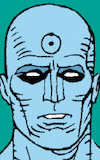
The page concentrates on vision and obstructed knowledge. Jon’s circular forehead mark resembles an unblinking third eye, yet tachyons prevent his near-omniscience from producing timely understanding; the final extreme close-up turns his eye into a frame containing another scene. Moore and Gibbons thus make sight itself paradoxical: Jon can perceive across time while remaining unable to grasp the present when it matters.
Themes
The page exposes the weakness concealed within godlike power: Jon reaches the correct conclusion but cannot coordinate knowledge, action, and emotional responsibility. Laurie’s urgent moral questions meet his belated, almost bureaucratic certainty. That irony sharpens Watchmen’s critique of exceptional beings whose vast capabilities do not guarantee ethical attention, and whose distance from ordinary time becomes a form of distance from ordinary suffering.
Graphic Novel Technique
Comics can place incompatible moments beside one another without resolving them into a single cinematic present, and this page exploits that capacity. Speech from different temporal positions appears in one reading sequence, while the eye panel embeds a scene within Jon’s perception. The reader must assemble chronology across gutters, briefly experiencing the same dislocation that governs Jon’s consciousness—a sophisticated use of simultaneity unusual in mainstream superhero comics of the period.