Notes on this page
Chapter 12, Page 07
Summary
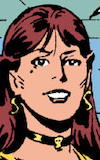
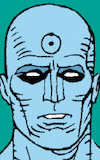
In the devastated New York street, Laurie identifies the time as midnight while Jon reappears, holding a newspaper and analyzing the tachyon interference that delayed him. Their reunion moves from shock to grimly comic bewilderment as Jon mistakes the monster’s enormous tentacles for “Tandoori to go,” revealing how little he yet understands the human catastrophe around them.
Panels
Three broad horizontal panels create a cinematic withdrawal: panel 1 holds close to Laurie’s tearful face, panel 2 places Jon prominently before the ruined street, and panel 3 pulls back to expose both characters as small figures amid bodies and wreckage. Coming after the previous page’s full-page revelation, this measured widening converts spectacle into aftermath; the following page’s return to the nine-panel grid then shifts attention from stunned observation to argument and investigation.
Environment
The wreckage is saturated with remnants of ordinary urban life: a “Bringing Light to the World” slogan, a newsstand, discarded newspapers, delivery litter, and bodies. These commercial messages survive as bitter fragments of a consumer city whose inhabitants have been annihilated; even Jon’s newspaper, still asking “WAR?,” has become obsolete beside an event no headline anticipated.
Color
John Higgins opposes Jon’s flat, cool blue to the feverish oranges, yellows, pinks, and sickly greens of the ruined city and the creature. Jon therefore appears eerily clean and visually detached, while Laurie remains chromatically embedded in the human world of blood, fire, flesh, and grief; the pools of black beneath them make the bright debris feel less lively than toxic.
Symbols
The giant creature remains present chiefly through fragments—spotted flesh, curling tentacles, and organic forms that invade every level of the page. This partial framing makes it less a single object than an environment engulfing the characters, while the inverted newspaper in Jon’s hands turns public information into a literally unreadable relic: the old narrative of impending war has been overturned by Veidt’s manufactured apocalypse.
Themes
The page stages a profound difference of scale between Laurie and Jon. She experiences the scene as human loss, while he initially treats it as a problem in temporal physics, calmly tracing tachyons and generators; his “Tandoori to go” error turns that estrangement into bleak comedy. The moment prepares Laurie’s demand on the next page that he stop theorizing and recognize the dead surrounding them.
Graphic Novel Technique
The page exploits comics’ ability to make speech and background evidence coexist without either disappearing: readers can linger over corpses and debris while Jon’s analytical dialogue proceeds at its unhurried pace. His final misunderstanding works because the eye can inspect the same tentacle he misreads, producing dramatic irony within a single panel. The transition from splash page to three strips to nine panels is a particularly controlled modulation of shock, comprehension, and debate.