
Notes on this page
Chapter 10, Page 16
Summary
In Happy Harry’s bar, Dan Dreiberg learns that a gang murdered Hollis Mason and erupts, threatening an informant until Rorschach restrains him. Outside, the partners regain their investigative purpose—linking the killings to the mask-killer theory and Veidt—while Dan’s grief turns toward an image of death as a voyage.
Panels
The strict nine-panel grid first contains a struggle that threatens to overflow emotionally: panels 1–3 move from a crowded medium shot to Dan’s looming close-up, then panels 4–6 abruptly release the pressure through withdrawal, an overhead exterior, and conversation on the street. Panels 7–9 slow into three reflective beats, ending with the men reduced to silhouettes; the following page converts their talk of death as a voyage into the literal departure of Veidt’s doomed island workers.
Environment
The bar’s Knot Top clientele and looming gang imagery make the setting an extension of the street violence that killed Mason; once outside, the Happy Harry’s sign and dirty, nearly empty pavement leave Dan’s grief exposed in an indifferent city. The final setting, before Archie’s enormous circular windows, shifts them from chaotic public space toward their hidden technological refuge.
Color
Hot reds, oranges, and bruised purples dominate the bar, making Dan’s owl costume less reassuring than feverish and predatory; Rorschach’s yellow-brown figure initially recedes behind his violence. Outside, the palette cools into gray-green masonry and pale yellow light, while the final panel drains the heroes into black silhouettes against Archie’s glowing circles, turning personal grief into stark abstraction.
Symbols
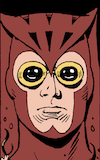
Masks govern the page’s moral reversals: Dan’s owl cowl magnifies his furious eyes, while Rorschach’s unreadable inkblot face becomes, unexpectedly, the face of restraint. The paired circular windows in panel 9 resemble immense eyes and echo Dan’s goggles, placing the two men beneath a visual emblem of watching that cannot guarantee understanding or protection.
Themes
The page overturns the partners’ usual ethical positions. Dan, commonly the gentler and more socially adjusted man, nearly becomes an executioner when violence reaches his surrogate father; Rorschach, the moral absolutist, invokes civilians and the needs of the investigation. Their exchange exposes how superhero ethics depend not only on principles but on whose trauma has just been touched, while their new evidence draws Veidt’s respectable public identity closer to hidden criminal machinery.
Graphic Novel Technique
The page makes meaning through controlled repetition and the reader’s pause across gutters: Dan’s rage occupies progressively tighter frames, then the final row restores distance one measured panel at a time. Most strikingly, the last dialogue about pharaohs, voyages, and steerage continues conceptually across the page turn, where an actual ship carries unwitting victims away—an unusually sophisticated verbal-visual handoff that gives Dan’s melancholy metaphor a sinister dramatic irony.