Notes on this page
Chapter 10, Page 15
Summary
At Happy Harry’s, Rorschach and Nite Owl interrogate a frightened Pyramid Deliveries freight handler about mysterious envelopes containing cash and assassination orders. His account links the scheme indirectly to Veidt and reveals that the other couriers have died; when he cannot identify Hollis Mason’s killers, Rorschach breaks his finger, turning investigation into punishment.
Panels
The strict nine-panel grid turns the interrogation into a tightening mechanism. Early medium shots accommodate testimony and background witnesses; panels 4–6 isolate fearful faces and reactions; panels 7–9 narrow into alternating frontal close-ups of Nite Owl and Rorschach before violence erupts partly below the frame. The page turn then reveals Rorschach’s coercion continuing, followed by the pair’s departure, converting the scream into momentum.
Environment
The crowded bar remains a hostile social theatre: costumed vigilantes stand among drinkers and Knot Tops while the interrogation unfolds almost publicly. The crucial environmental detail is institutional rather than decorative—Pyramid Deliveries, a Veidt-connected company, becomes the mundane logistical channel for concealed violence, suggesting that corporate systems can hide conspiracy more effectively than any supervillain’s lair.
Color
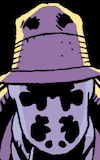
John Higgins binds the scene with aggressive reds, oranges, and bruised purples against heavy black, making the bar feel overheated and morally airless. Rorschach’s yellow mask is the strongest figure-ground contrast, repeatedly pulling the eye toward his impassive face; the warm palette therefore does not create comfort, but makes fear, anger, and bodily threat feel immediate.
Symbols
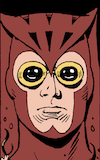
Masks dominate the page, but Gibbons contrasts literal masks with exposed faces. Nite Owl’s round lenses register stunned comprehension, Rorschach’s shifting inkblots remain unreadable, and the informant’s uncovered face becomes increasingly distorted by fear; identity here is not concealed versus revealed so much as controlled versus vulnerable. Rorschach’s final inkblot resembles an open, screaming mouth, visually echoing the victim’s cry.
Themes
The page exposes the moral danger of vigilante certainty. Rorschach treats the handler’s fear and partial knowledge as sufficient grounds for torture, while Nite Owl’s discovery that Mason’s death may belong to the larger conspiracy lends their investigation urgency without validating Rorschach’s methods. The irony is central to Watchmen: heroes seeking hidden criminal power readily exercise unaccountable power themselves.
Graphic Novel Technique
Comics lets the reader hold all nine stages of the encounter in view at once, comparing masks, faces, and escalating scale while choosing how long to pause over the testimony. The gutters make the decisive violence especially disturbing: between panels 8 and 9, Rorschach’s threat becomes an action shown only through hands, fragments, and sound. That calculated omission recruits the reader’s imagination rather than offering cinematic spectacle.