
Notes on this page
Chapter 10, Page 10
Summary
Inside Nite Owl’s submerged craft, Rorschach and Dan Dreiberg turn their investigation from the supposed “mask killer” toward Adrian Veidt, connecting Blake’s island remark, Moloch’s employment, and Veidt’s staged assassination attempt. Their argument then becomes personal: Rorschach apologizes, calls Dan a good friend, and the two reconcile with a handshake.
Panels
Gibbons uses the regular nine-panel grid as three measured movements: deduction across panels 1–3, confrontation and apology across 4–6, then reconciliation across 7–9. The lower tier repeats nearly the same frontal composition while Rorschach’s hand remains extended; this slowed, almost awkward duration makes Dan’s eventual acceptance feel earned rather than automatic.
Environment
The cramped, instrument-filled cabin makes detective work feel enclosed and secretive, while the riverbed seen through the craft’s round windows literalizes Dan and Rorschach’s descent beneath the public story. The next page converts that metaphor into action when they rise toward the city and its “criminal fraternity.”
Color
Muted greens and browns unify the claustrophobic interior, while sharp yellow circles in the windows punctuate the investigative discussion like watchful eyes. In the final row, Rorschach’s blue-purple glove moves against Dan’s subdued costume, directing attention toward the offered hand and allowing a small physical gesture to carry the page’s emotional climax.
Symbols
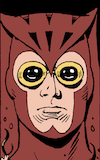
Masks dominate the page, but their emotional functions change: Rorschach’s fixed face protects him from intimacy, while Dan removes his owl cowl before their reconciliation. The craft’s paired circular windows repeatedly resemble eyes, turning their investigation into an act of looking; by panel 9, however, the significant contact is tactile—the clasped hands beneath Dan’s exposed face.
Themes
The page joins conspiracy-solving to an inquiry into friendship. Rorschach’s absolutist suspicion produces a plausible case against Veidt, yet the same habits make him cruel to Dan; his apology reveals that beneath the uncompromising persona lies a damaged man capable of dependence, gratitude, and difficult moral self-correction.
Graphic Novel Technique
Comics lets the reader hold the entire grid at once and compare repeated poses for minute changes: a removed mask, an extended hand, a softened expression, a delayed handshake. The intellectual revelation and emotional reconciliation therefore proceed in parallel visual patterns, a sophisticated use of the superhero grid in which continuity of framing makes vulnerability—not action—the decisive event.