
Notes on this page
Chapter 9, Page 12
Summary
At Sally Jupiter’s reunion of former costumed adventurers, thirteen-year-old Laurie resents being trained to inherit her mother’s identity and is confronted with the damaged Byron Lewis, once Mothman. A spilled drink then carries the page from Laurie’s memory back to Mars, where her argument with Jon about whether human struggle gives life meaning continues.
Panels
The strict nine-panel grid begins with six crowded, dialogue-heavy reunion scenes, then abruptly simplifies. Panel 7 isolates the breaking bottle in black space; panel 8 repeats the impact in the memory; panel 9 returns to Mars. These match cuts compress decades without explanation, while the reader reconstructs the temporal shift from repeated shapes, captions, and liquid. The previous page’s sociable bustle therefore ends here in fracture, and the following page can open fully into Jon and Laurie’s philosophical dispute.
Environment
The comfortable party—cocktails, school blazers, domestic furniture—turns superhero history into an awkward alumni gathering rather than a heroic spectacle. Byron’s distress exposes what this nostalgic setting tries to contain: beneath the respectable clothes and genial reminiscence lies the psychological damage produced by the costumed era.
Color
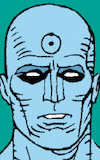
Muted domestic greens, browns, and clothing colors make the reunion feel ordinary until panel 7’s saturated purple-and-yellow bottle explodes against black like an object in space. Panel 8’s monochrome orange converts that visual shock into traumatic memory, while panel 9 restores Mars’s hot oranges and Jon’s cool blue, placing Laurie’s human warmth and his detachment in immediate chromatic opposition.
Symbols
Spilling is the page’s governing motif. Byron’s dropped glass literalizes Laurie’s phrase about people being left broken and “spilling everything,” while the shattered perfume bottle against black gives that idea a symbolic, almost cosmic form; the liquid Laurie pours on Mars then completes the chain, making memory itself seem like something released by accident.
Themes
The page dismantles heroic nostalgia by showing its inheritance as coercion and its aftermath as damage: Laurie experiences her mother’s ambitions as an imposed destiny, while Byron embodies a life broken by the role. This memory answers Jon’s abstraction with evidence; “accomplishing nothing” is not a neutral philosophical proposition to Laurie, because human effort leaves vulnerable people, consequences, and obligations behind.
Graphic Novel Technique
Comics allows three times and two worlds to occupy one visible grid: adolescent memory, its symbolic condensation, and the Martian present. The reader may pause over the bottle, glass, and poured drink simultaneously, discovering the transition spatially rather than receiving a filmed dissolve or prose explanation. That fusion of verbal association and graphic match is a particularly sophisticated use of mainstream superhero comics’ page architecture.