
Notes on this page
Chapter 9, Page 04
Summary
On Mars, Laurie recovers from Jon’s accidental failure to provide breathable air and angrily confronts him about his inhuman carelessness. Their quarrel is abruptly dwarfed by the revelation of Jon’s immense glass palace, shifting the page from bodily distress and intimate conflict to architectural awe.
Panels
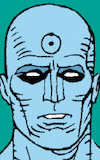
Three regular panels compress the argument into increasingly close framing: a two-shot, a tighter confrontation, then Jon’s impassive face dominating the foreground while Laurie stands behind him. The enormous fourth panel breaks that rhythm with a long-shot reveal; after the previous page’s frantic descent and choking close-ups, its scale makes the quarrel seem suddenly minute without resolving it.
Environment
The empty Martian landscape offers no social world, only rocks, stars, and Jon’s impossible construction. That absence matters: without Earth’s crowds, products, politics, or institutions, Laurie’s ordinary clothes and physical vulnerability become the page’s clearest reminders of human life.
Color
Against the black sky, Jon’s cool blue body remains visually remote from Laurie’s warm brown and yellow clothing. The palace floods the lower panel with saturated pinks, violets, and acidic yellows, turning the hostile landscape into a dazzling spectacle whose beauty cannot erase the emotional coldness that produced the preceding mistake.
Symbols
The palace’s circular mechanisms and needle-like towers resemble an enormous exposed clockwork, extending the chapter’s concern with time, causality, and predestination. Jon and Laurie appear tiny beside it, while its intricate order suggests both his godlike power and his tendency to understand existence as a system rather than as lived human experience.
Themes
The page exposes the gulf between possessing power and exercising responsibility: Jon can teleport Laurie across space and build a monumental palace, yet forgets that she needs air. His creation therefore carries a sharp irony—cosmic mastery set beside elementary negligence—while Laurie’s anger insists that human dependence and feeling cannot be dismissed as trivial details.
Graphic Novel Technique
Comics lets the architectural reveal occupy physical space on the page: the reader moves from three quick conversational beats into a panel that demands a slower scan downward across the palace before finding the tiny couple. The following page then returns to subdivided panels and philosophical debate, so this near-splash functions as a visual hinge between immediate bodily danger and the chapter’s argument about fate.