
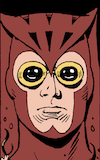
Notes on this page
Chapter 8, Page 24
Summary
Knot Top gang members break into Hollis Mason’s home, believing the retired Nite Owl responsible for the prison riot. Hearing them descend, Hollis moves toward the relics of his heroic past and confronts the intruders in his basement, turning an invasion into a grim reprise of his costumed career.
Panels
Six equal panels occupy the upper two-thirds before a double-width final panel opens the basement into a stage for confrontation. The sequence cross-cuts between Hollis moving inward and the gang moving downward, so the reader watches two paths converge; panel 6 delays recognition with an almost abstract pair of glowing circles, and the wide panel 7 releases that suspense by revealing the opposing groups within one continuous space. The previous page’s abrupt cut from Dan’s escape to Hollis’s home makes the older man’s peril feel like collateral damage from Dan’s return to vigilantism.
Environment
The basement is both workshop and private museum: machinery, an aircraft-like relic, and the old owl costume preserve the material remains of Hollis’s identity. The intruders turn this nostalgic refuge into a trap, while their loose talk of “the captain’s attitude” shows mob violence spreading through imitation, rumor, and the gang’s improvised hierarchy.
Color
Muted industrial grays and browns dominate the basement, punctured by yellows, reds, and pinks. Most strikingly, the round yellow-lit opening behind the stored equipment echoes the yellow beam extending into the black passage: color guides the eye from Hollis’s relics toward the approaching violence, making the darkness feel less empty than actively penetrated and exposed.
Symbols
The strongest motif is the owl face formed by two luminous circular “eyes” in panel 6. Emerging from near-total darkness, it briefly converts obsolete equipment into the image of a living mask: Hollis’s past seems to awaken, but the effect is ominous rather than triumphant, since the costume and its symbols cannot restore his youth or control the present.
Themes
The page tests nostalgia against history. Hollis has treated masked adventure as a recoverable, honorable past, but the Knot Tops collapse the distinction between the first and second Nite Owls and punish him for a present in which he played no part. That cruel misidentification advances the chapter’s concern with inherited identities: public symbols outlive individual intentions, and violence attaches itself to the mask rather than the person beneath it.
Graphic Novel Technique
Comics lets the reader hold Hollis and his attackers in parallel before they meet, controlling the suspense by lingering over the gutters between their separate movements. Panel 6 is especially effective because its circles can be read first as an owl’s eyes and only afterward as part of the basement environment; the page exploits stillness and graphic resemblance to make recognition unstable in a way prose would have to explain and film would reveal almost immediately.