
Notes on this page
Chapter 7, Page 26
Summary
After rescuing residents from a burning tenement, Laurie clears the civilians from Archie while Dan pilots the owlship and sings along with “You’re My Thrill.” Once they are alone, relief and exhilaration become intimacy: Laurie recognizes the song, sees herself reflected in Dan’s goggles, and kisses him.
Panels
The eight-panel design expands the middle-left rescue scene across two columns, giving the civilians’ departure public weight before the bottom row contracts into three private beats: conversation, reflected gaze, kiss. Page 25 ends with Archie airborne; this page slows from emergency action into romantic recognition, while the silent montage on page 27 turns the kiss into an eroticized sequence of buttons, bodies, ignition, and flight.
Environment
The owlship’s coffee machine, stairwell, control panels, and bulbous seats make superhero technology feel oddly domestic—a temporary shelter as well as a fantasy vehicle. Outside, fire crews and displaced residents gather beneath the hovering craft, grounding Dan and Laurie’s renewed heroism in an ordinary civic emergency rather than an abstract supervillain battle.
Color
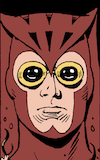
Cool blue-greens and violets dominate Archie’s interior and the nighttime crowd, allowing Laurie’s yellow clothing and red hair to remain the page’s visual anchor. Dan’s warm orange-brown mask in panel 2, framed by smoke and darkness, marks the return of costumed vitality; the final kiss brings his reddish cape around Laurie’s yellow figure, enclosing the pair in a warmer, more intimate field.
Symbols
Masks here enable rather than conceal: Dan’s owl goggles accompany a confidence absent from his civilian life, while Laurie’s reflection in one circular lens visually places her inside his heroic identity and desire. The repeated round forms—the moon, Archie’s windows, and the goggles—bind costume, vehicle, and intimacy; the owl-eye reflection also suggests that Dan can finally see Laurie clearly only after becoming Nite Owl again.
Themes
The page links heroic competence with recovered sexual and emotional confidence. Dan’s cheerful singing after the rescue contrasts sharply with his earlier hesitation and impotence: the costume is not merely nostalgic dress but a structure through which he can act, desire, and be desired. Moore nevertheless leaves an uneasy question active—whether this renewal belongs to Dan himself or to the Nite Owl performance he has resumed.
Graphic Novel Technique
The song supplies an elastic bridge across locations and actions: its lyrics continue from the previous page, pass through Dan’s masked close-up, and are identified only after the rescue, turning background music into courtship. Comics can hold the public spectacle, private dialogue, Laurie’s image inside Dan’s lens, and the anticipatory page turn in a single visual rhythm—a particularly sophisticated fusion of montage, motif, and reader-controlled timing.