
Notes on this page
Chapter 7, Page 18
Summary
In Dan Dreiberg’s apartment, immediately after his apocalyptic nightmare and failed intimacy with Laurie, Dan silently leaves the bedroom, crosses to the hidden basement, and retrieves his Nite Owl costume and goggles. The page changes humiliation into decision: unable to act as an ordinary lover, he prepares to recover agency through his masked identity.
Panels
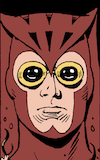
Gibbons returns to a strict nine-panel grid after the previous page’s disruptive nightmare montage. The silent, evenly measured sequence slows Dan’s movement into a ritual: door, window, stair, machinery, locker, costume, goggles. Successive silhouettes withhold his face and identity until panel 8 reveals the suit; panel 9 then supplies a tight insert whose circular lenses motivate the binocular viewpoint opening the following page.
Environment
The domestic interior gradually gives way to the Owlship hangar: window, stairwell, railings, industrial machinery, and locker form a descent from everyday life into Dan’s concealed heroic past. His costume hanging like an abandoned uniform makes the basement feel less like a headquarters than a museum of a self he has tried—and failed—to retire.
Color
The page moves from sickly yellow domestic light to muted violet, blue-gray, and black in the basement, making Dan’s descent feel both secretive and funereal. Against that darkness, the gold goggles and their glossy magenta lenses become the decisive visual accent: the brightest object is not Dan’s body but the instrument of his masked persona.
Symbols
Circular forms organize the page: the mark Dan traces through condensation, the great wheel-like machinery, and finally the owl goggles. These eye shapes transform private anxiety into technologically enhanced vision; the last panel turns the mask into something he can hold and choose, while the following page makes those same lenses the frame through which he sees Laurie.
Themes
Dan’s impotence is presented as a crisis of identity rather than merely of sexuality. The previous page links intimacy to nuclear annihilation and helplessness; here, he answers that helplessness by returning to the role in which action, competence, and masculinity once seemed possible. The irony is poignant: his heroic costume offers genuine courage, but also functions as an emotional prosthesis.
Graphic Novel Technique
With no captions or dialogue, the page makes the reader perform the psychological connection between bedroom failure and heroic reawakening across the gutters. Repeated framings and controlled reveals turn dressing into suspense without showing Dan actually put the costume on. The final close-up also creates a precise page-turn hinge: an object seen externally becomes, on the next page, the optical device through which the scene is viewed.