Notes on this page
Chapter 7, Page 01
Summary
Laurie Juspeczyk explores Dan Dreiberg’s basement workshop, moving from his owl costume to the looming Owlship and finally climbing into its cockpit. The silent sequence turns casual curiosity into absorbed play: Laurie crosses from observing Dan’s retired heroic identity to inhabiting its machinery, setting up the accidental ignition on the following page.
Panels
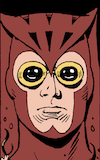
Gibbons uses the regular nine-panel grid as a controlled approach: three close views of owl imagery, three medium or long views charting Laurie’s movement, then three shots that carry her across the hatch and into the cockpit. Repeated frontal compositions make costume and vehicle appear almost animate. The measured silence also loads the page turn, where one pressed control produces an explosive horizontal panel.
Environment
The workshop is less a heroic headquarters than a dim industrial storage space: cracked masonry, exposed pipes, scaffolding, tools, and dormant machinery surround meticulously preserved costumes and vehicles. That contrast makes Dan’s past look simultaneously grand and obsolete—a private museum of technological fantasy hidden beneath an ordinary life.
Color
Muted greens and blue-grays bind the underground workshop into a cool, dormant space, while Laurie’s pink clothing and dark red hair keep her visually mobile through it. Cream-colored windows and hatch surfaces resemble blank illuminated eyes; these restrained tones make the following page’s sudden yellow-orange jet of flame feel like the violent awakening of stored power.
Symbols
Eyes dominate the page. The costume’s goggles, the Owlship’s paired windows, and the circular hatch repeatedly transform objects into watchful faces, extending the owl motif from emblem to environment. Yet these eyes do not guarantee control: Laurie enters a machine whose controls she does not understand, preparing the comic reversal from surveillance to dangerous blindness.
Themes
The page treats superhero identity as something material that can be stored, displayed, entered, and reactivated. Laurie’s passage from costume to vehicle quietly parallels Dan’s suppressed longing: the old heroic life remains available beneath the surface, but its power is neither innocent nor fully manageable. Nostalgia here is seductive equipment with live controls.
Graphic Novel Technique
With almost no text, the page makes the reader supply movement and curiosity across the gutters: a glance at the costume becomes descent, approach, entry, and touch. Because all nine moments remain visible at once, the page can build a visual argument from repeated owl-eyes while preserving suspense about causation—a sophisticated use of silent sequencing whose punch line and danger arrive only after the turn.