Notes on this page
Chapter 5, Page 28
Summary
After leaping through the window, Rorschach is overwhelmed by police, beaten, and unmasked as Walter Kovacs. His arrest changes the conflict from a hunt for a mysterious vigilante into the public exposure of a frightened, injured man whose authority depended upon his mask.
Panels
The regular grid converts a chaotic arrest into a sequence of hard, enclosing units. Rorschach’s fall in panel 1 is followed by a central panel of collective restraint, then progressively tighter framings of mask, face, and abandoned shoe; physical action contracts into forensic revelation. As the closing page of Chapter V, it also completes the chapter’s larger mirror structure, answering its opening through reversed compositions and motifs.
Environment
The rain-soaked alley is a world of broken glass, rubble, boots, cameras, and jeering spectators: the city does not merely witness Rorschach’s fall but turns it into a public spectacle. The crossed-bones sign overlooking the arrest lends the setting a grim commercial heraldry, while the puddle and debris reduce the former avenger to something discarded in the street.
Color
Hot reds, oranges, and yellows dominate the fall and beating, making the police assault feel feverish and theatrical; cooler blue-violets enter around the officers and exposed face, sharpening the humiliation. In the final images, the crossed-bones sign and puddle repeat shapes and colors in degraded form, turning visual balance into an image of collapse rather than harmony.
Symbols
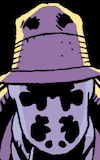
The crucial symbol is the mask, first presented as Rorschach’s face and then pulled away like a sack, revealing Kovacs beneath. His cry—“My face! Give it back!”—makes identity material rather than metaphorical: the shifting inkblots are, to him, the true self, while the biological face is the disguise. The discarded elevator shoe likewise exposes the artificial construction of his intimidating persona.
Themes
The arrest exposes the fragile performance beneath Rorschach’s moral absolutism. Police ridicule his smell, sexuality, height, and hidden shoes, replacing the feared urban myth with a socially abject man; yet their brutality complicates any easy triumph of law over vigilantism. The Blake quotation finally names the chapter’s governing irony: institutions can capture Kovacs, but neither they nor he can comfortably explain the “fearful symmetry” of violence used to impose order.
Graphic Novel Technique
Comics lets the reader hold Rorschach’s constructed identities beside one another at once: masked figure, discarded mask, naked face, deceptive shoe, and reflected sign remain visible across the grid. The inset Blake quotation and clock transform the chapter ending into commentary on its architecture, making the page simultaneously narrative climax, visual rhyme, and instruction for rereading—an unusually rigorous formal design for mainstream superhero comics of the period.