
Notes on this page
Chapter 5, Page 16
Summary
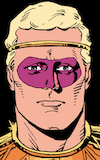
In the lobby of the Veidt building, Adrian Veidt restrains the wounded assassin, discovers too late that the man has bitten a poison capsule, and watches him die. Veidt then moves instantly from attempted interrogation to corporate damage control, ordering the cancellation of an Ozymandias toy-line expansion and dictating how the attack should be explained publicly.
Panels
Eight panels reshape the familiar nine-panel grid: a double-width opening panel establishes Veidt’s dominance, then narrow frames and abrupt close-ups slow the search of the attacker’s mouth into a tense forensic sequence. The bottom row widens again as the body collapses and Veidt withdraws; the final panel converts physical action into managerial command. The previous page supplies spectacular combat, while this page replaces motion with scrutiny, failure, and calculation.
Environment
The setting turns heroism into corporate spectacle: Veidt’s purple-and-gold clothing echoes the monumental “V” architecture, Egyptian ornaments, and proposed Ozymandias merchandise. Even the fountain becomes part of the violence, its water and toppled decorations surrounding the corpse; the guards’ helplessness suggests that Veidt’s institution depends less on ordinary security than on its owner’s exceptional personal power.
Color
Veidt’s saturated purple suit and the building’s gold-yellow surfaces make him visually continuous with his branded environment, as though man, costume, and corporation share one identity. Against that controlled palette, scarlet blood and pale blue fountain water spread across faces, hands, and clothing, turning the immaculate lobby into evidence that violence cannot be kept outside Veidt’s carefully designed public image.
Symbols
The page concentrates attention on mouths, first as the object of Veidt’s command, then in invasive close-up as he searches the attacker, and finally as the mechanism of suicide. Speech, secrecy, and control converge around the mouth: Veidt can physically overpower the man but cannot compel disclosure, while his final dialogue shows him compensating by controlling what everyone else will say about the event.
Themes
The crucial irony is that Veidt responds to an assassination attempt as both superhero and executive: he tries to save information from the dying man, then immediately manages products and publicity. His instruction to claim that he has no enemies exposes the gap between public image and private reality. On the following page, a newspaper headline converts the attack into mass-media narrative, showing his preferred account already escaping his control.
Graphic Novel Technique
Comics lets the reader linger over the tiny interval in which Veidt realizes he has failed: hand in mouth, impassive close-up, victim’s convulsion, extraction, collapse. That expanded moment contrasts sharply with the compressed corporate orders that follow. The page turn then places the public report beside the pirate comic’s imagery of severed heads, creating an unsettling parallel between superhero news and embedded fiction—an unusually sophisticated orchestration of action, media, and commentary.