


Notes on this page
Chapter 4, Page 22
Summary
In 1985, Dr. Manhattan begins constructing his Martian refuge from sand while remembering the 1977 police strike, when Laurie persuaded him to suppress a riot in New York. His calm intervention disperses the crowd but reportedly causes two fatal heart attacks, turning an apparently efficient act of peacekeeping into evidence of his frightening disproportionate power.
Panels
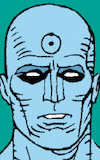
Six panels expand the nine-panel grid into three narrow units, a two-thirds-width confrontation paired with a close-up, and a full-width aftermath. The move from distant spectacle to Manhattan’s enormous, impassive face makes Laurie’s request feel alarmingly small; the final long shot then restores distance, leaving the reader to measure the human cost scattered beneath his hovering figure. The page turn leads from this practical exemption from ordinary limits to his formal exemption under the Keene Act.
Environment
The White House behind Manhattan in panel 6 makes the consequence unmistakably political: he is not merely a superhero but an instrument operating beside the seat of state power. Abandoned placards and scattered rubbish record the riot’s collapse, while the crude anti-mask rhetoric places the scene within the public backlash that leads directly into the Keene Act on the following page.
Color
John Higgins sharply separates times and emotional registers: Mars is black, pink, and cold blue; the riot burns in compressed reds and yellows; the aftermath drains into pale gray-green beneath the White House. Manhattan’s blue body remains nearly unchanged across these palettes, visually suggesting a being who passes through radically different human crises without being altered by their emotional temperature.
Symbols
Sand is the page’s central motif. In the opening panel Manhattan holds it as infinitely pliable matter, and its downward stream is echoed by his descending body over the crowd and by the vertical bars of the White House fence. Creation, intervention, and confinement thus share a visual grammar: matter and people alike appear to fall into arrangements imposed by his hands.
Themes
The page stages the central political danger of Manhattan’s power: his intervention is effective, bloodless in appearance, and nevertheless lethal. His statement that Laurie’s appeal was “not a request” reveals how intimacy, governmental authority, and coercion have become entangled; the frightened crowd obeys because resistance is inconceivable. His retrospective certainty about additional deaths also exposes the chill of judging human suffering statistically.
Graphic Novel Technique
Comics allows 1985 Mars, 1977 unrest, and its aftermath to remain visible together on one page, making Manhattan’s nonlinear memory a spatial experience for the reader. Caption boxes carry his serene retrospective voice across violently changing images, while the gutters perform enormous jumps in time and place without disrupting his consciousness. This controlled montage is a particularly sophisticated transformation of superhero action into historical and ethical argument.