


Notes on this page
Chapter 4, Page 20
Summary
In Vietnam, Dr. Manhattan’s overwhelming presence compels Vietcong soldiers to surrender, their fear mingled with religious awe. The chronology then jumps to the Comedian’s unexplained shooting and finally to Mars in 1985, where Manhattan turns away from the photographs he has burned and declares that he no longer wishes to look at dead things.
Panels
Four radically unequal panels turn chronology into design: the immense Vietnam image occupies most of the page, while three narrow panels on the right compress surrender, the Comedian’s shooting, and Manhattan’s retreat to Mars. Coming after the Comedian’s claim that he understands humanity and does not care, the page contrasts his brutal engagement with Manhattan’s withdrawal; the following page then resumes the chronology with the Antarctic visit to Veidt.
Environment
Helicopters, burning jungle, and surrendering soldiers make Vietnam less a conventional battlefield than a demonstration of American technological supremacy. The comparison with Hiroshima places this alternate-history victory within a disturbing continuum: Manhattan’s body has become both superweapon and spectacle, while the later Martian emptiness shows the emotional destination of that power.
Color
Manhattan’s pale cyan body is held against violet skies and intensely saturated red-orange explosions, making him eerily cool and untouched within the violence he enables. Down the right-hand column, the palette darkens from sickly military greens and purples to the near-black Martian sky, where pink ground and the tiny blue figure turn political spectacle into cosmic isolation.
Symbols
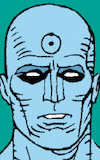
The page’s governing motif is Dr. Manhattan’s changing scale. He towers like a walking atomic god over Vietnam, appears human-sized beside the wounded Comedian, and ends as a tiny blue figure against black space; the progression converts physical omnipotence into emotional diminishment. His hydrogen-atom mark and the mushroom-like clouds reinforce the soldiers’ comparison of him to the atomic bomb.
Themes
The surrendered soldiers expose the authoritarian logic beneath benevolent superpower: obedience arises not from persuasion but from terror and awe. Manhattan recognizes the analogy with Hiroshima, yet recognition does not become responsibility; by October 1985 he answers the burden of human death by refusing to look. The page therefore makes detachment, rather than cruelty, his characteristic moral failure.
Graphic Novel Technique
Comics allows Manhattan’s gigantic May 1971 presence and his tiny October 1985 solitude to coexist on one unmoving page, so the reader can compare them instantly while still reading them sequentially. The captions treat memory as a series of precisely dated presents, and the unequal grid spatializes that experience: one moment expands monumentally while fourteen years collapse through three panels, a particularly sophisticated use of page architecture and temporal montage.