



Notes on this page
Chapter 4, Page 16
Summary
In 1963, Janey Slater confronts Jon Osterman in their bedroom about his foreknowledge: he knew President Kennedy would be shot yet did nothing, and he speaks of their past and immediate future as equally present. A delivery mistake involving earrings briefly interrupts the quarrel; frightened by Jon’s detachment, Janey asks him to hold her, and he complies.
Panels
The strict nine-panel grid contains an argument that keeps threatening to exceed ordinary chronology. The first row moves from Kennedy’s shooting to Jon’s claim that the future is already occurring, while the middle row interrupts metaphysical conflict with a doorbell; the nearly wordless handling of the earrings below slows the reader before the uneasy embrace. The following page then expands Jon’s temporal dislocation across 1964, 1966, and 1985.
Environment
The enormous newspaper headline in panel 1 turns a national trauma into the backdrop for a private argument. Its tabloid urgency contrasts with the ordinary apartment, dressing gowns, doorbell, and misdelivered jewelry: Jon’s transformation has not produced a grand heroic arena, but an increasingly unlivable domestic world in which alternate history is registered through media and conversation.
Color
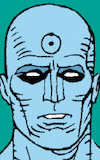
John Higgins sets Jon’s cool blue body against peach-orange walls and Janey’s intensely red sweater, making his emotional distance visible inside a heated domestic space. Wally’s dark clothing enters through a hard rectangle of yellow doorway light, briefly turning an innocuous delivery into a threatening intrusion; the final wider shot restores the warm room, but Jon remains a cold vertical presence.
Symbols
The earrings are the page’s crucial motif: small circular objects that arrive through an apparent mistake yet confirm Jon’s knowledge of what is about to happen. Passed from Wally to Janey under Jon’s gaze, they become a miniature test of determinism—evidence that his future may be fixed, but also that his refusal to explain or intervene has human consequences.
Themes
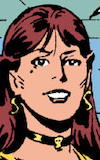
Janey states the page’s central indictment: Jon understands everything except people. His claim that he cannot prevent the future because it is already happening converts omniscience into an excuse for passivity, exposing the ethical problem beneath his superhuman perspective. Her final request to be held is painfully ironic: she seeks human protection from the very person whose power and fatalism have made her feel unsafe.
Graphic Novel Technique
Comics can place different kinds of time side by side without resolving them into a single cinematic present. The reader sees Kennedy’s headline, hears Jon describe 1959 and the imminent future, and then watches the predicted earrings arrive within one fixed grid; because all nine panels remain visible at once, the page gives formal shape to Jon’s simultaneous perception while preserving Janey’s ordinary, sequential experience of shock.