


Notes on this page
Chapter 4, Page 14
Summary
Dr. Manhattan moves through three public moments in his early career: meeting Ozymandias at a 1960 charity gathering, attacking Moloch’s vice den that November, and speaking with President Kennedy in September 1961. His detached recollection then leaps ahead to Kennedy’s assassination, turning apparent national confidence into foreknown catastrophe.
Panels
The page replaces the usual nine discrete units with three broad horizontal panels, each occupying a full tier and containing an entire historical episode. This enlarged montage rhythm makes years pass in three measured beats—June, November, September—before the final caption folds 1963 into 1961; the previous page’s television memory flows into this chronology, while the following page resumes it in May 1962.
Environment
The costumes, ballroom, press cameras, presidential balcony, and packed vice den place Dr. Manhattan inside institutions of celebrity, policing, and government rather than outside society. These settings make the alternate history tangible: superheroes have become a social class, Manhattan serves the Pentagon, and Kennedy publicly welcomes a genuinely superhuman American asset.
Color
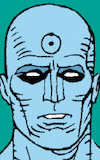
John Higgins gives each episode a distinct emotional climate: the charity gathering is cool and pastel, the vice den erupts in saturated reds and oranges, and the White House scene is drained toward white, pale green, and institutional gray. Dr. Manhattan’s blue body remains the stable visual constant, emphasizing that human history changes around an observer who seems chromatically and emotionally untouched.
Symbols
Masks function here less as concealment than as public performance: the costumed adventurers gather for publicity while Ozymandias already attracts Manhattan’s interest as an exceptional individual. The clearest recurring motif is temporal doubling: Kennedy’s handshake is visually haunted by the captioned image of his head snapping forward two years later, making ceremony and death coexist.
Themes
The page sharpens the chapter’s central conflict between knowledge and agency. Manhattan can say what Kennedy will ask and what will happen in Dallas, yet narration offers no suggestion that foreknowledge produces intervention; similarly, he admits that the morality of his violent raid escapes him, separating immense power from ethical certainty and exposing the limits of conventional superhero responsibility.
Graphic Novel Technique
Comics lets the reader hold three eras—and, in the final panel, two moments within one image—on the same page. Captions convert visible scenes into Manhattan’s simultaneous consciousness: the handshake remains present while its fatal future is already known. That tension between a fixed printed layout and nonlinear experience is a particularly sophisticated adaptation of form to character.