Notes on this page
Chapter 4, Page 05
Summary
Jon Osterman follows Wally Weaver into the Gila Flats bar, where a momentary vision of the room as a future ruin gives him déjà vu; Wally then introduces him to Janey Slater. Their tentative flirtation becomes a compressed history of intimacy and collapse, ending in 1966 with Janey packing and their photograph lying torn at Jon’s feet.
Panels
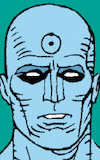
The seven-panel design expands the central encounter into a wide close-up, then contracts the relationship into three abrupt lower panels. Panel 2 is the crucial rupture: between Jon entering the bar and meeting Janey, the same location appears deserted, with his blue future body standing where his human self will soon socialize. The page thus makes time spatially simultaneous, while the bottom-row leaps from courtship to 1963 and 1966 accelerate years into seconds; the page turn carries the fallen photograph into the following page’s black field.
Environment
The ordinary bar—crowded tables, beer taps, pinboard photographs, and casually social coworkers—temporarily appears in panel 2 as an abandoned shell beneath a star-filled void. That intrusion of cosmic desolation into an unremarkable workplace shows how Jon’s later perception has contaminated memory: no setting remains merely present, because he experiences its eventual absence as already real.
Color
Warm browns, peach skin tones, and institutional greens initially make the bar feel social and bodily, but panel 2 drains that warmth into gray-green decay, black space, and Dr. Manhattan’s cold blue. The final yellow and pink panels are almost unnaturally bright: Higgins uses pop saturation not to preserve happiness, but to isolate remembered sensations and emotional damage with the stark clarity of exhibits.
Symbols
The photograph is the page’s central object: first a background snapshot that helps Janey identify Jon, then the image of the couple torn and discarded after their relationship fails. Hands reinforce the motif, moving from conversational gesture to the almost-touch over a cold beer; intimacy is reduced to a tactile instant that Jon remembers alongside its ending. On the following page, the photograph floats against black space, turning private memory into temporal debris.
Themes
The page makes dramatic irony into a theory of Jon’s consciousness: he meets Janey while already narrating their separation, so romance and loss occupy the same present tense. His statement that the illusion vanishes before it registers applies both to the restored bar and to intimacy itself. Human agency becomes painfully uncertain when an entire relationship is perceived as a fixed sequence whose ending is already visible at its beginning.
Graphic Novel Technique
Comics can place mutually exclusive moments beside one another without dissolves or explanatory transitions, and this page exploits that capacity with unusual sophistication for a mainstream superhero comic of the period. The reader may linger over Jon and Janey’s first exchange even while the lower panels display its aftermath; captions bridge the gutters across seven years, while repeated objects—the bar, beer glass, and photograph—make temporal jumps legible through visual association rather than continuous action.