
Notes on this page
Chapter 3, Page 13
Summary
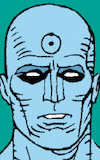
On a television set, Dr. Manhattan faces questions from Nova Express reporter Doug Roth about former associates who died of cancer. The interview’s controlled atmosphere is intercut with Laurie and Dan’s increasingly brutal fight against a street gang, so that both confrontations escalate: one through insinuation, the other through physical violence.
Panels
Six panels expand the underlying nine-panel grid into an alternating 1/3–2/3, 2/3–1/3, 1/3–2/3 pattern. This creates a visual zigzag between interview and fight: Roth’s verbal blows accompany Laurie and Dan’s physical ones. The page ends on the largest violent image, then the following page reverses the emphasis as the interview itself becomes openly damaging.
Environment
The studio’s cameras, press badges, microphones, and gathered audience turn accusation into a carefully staged public spectacle. By contrast, the street is flattened into an almost abstract arena, stripped of ordinary urban detail; institutions manufacture Manhattan’s crisis under bright lights while anonymous citizens enact social breakdown outside.
Color
The two locations are separated less by naturalistic space than by palette. Manhattan’s cool cyan stands out against the studio’s pink, black, and subdued gray crowd, while the fight burns in red, orange, and acid yellow. Those hot, compressed fields make violence feel immediate, yet Manhattan’s isolated blue gives the quieter interrogation an equally severe emotional pressure.
Symbols
The strongest motif is performance under observation. Manhattan’s immense power is contained within a suit, a chair, and the reporters’ gaze, while Laurie and Dan—still in civilian clothes—begin performing the violent competence of their former masked identities. The repeated crowds make both scenes public trials, blurring the distinction between witness, audience, and participant.
Themes
The page exposes the fragility of public identity. Manhattan can dominate matter but cannot control the story being assembled around him; Roth converts private relationships and deaths into evidence before a mass audience. Meanwhile, Laurie and Dan recover agency through violence. The juxtaposition asks whether power resides in physical capacity or in the authority to define events publicly.
Graphic Novel Technique
Comics allows the interview and fight to remain simultaneously present, inviting the reader to compare gestures and verbal rhythms without a film editor fixing their duration. Dialogue about death and conflict bridges separate spaces, turning cuts into arguments rather than mere transitions. This tightly patterned counterpoint is a particularly sophisticated use of mainstream superhero-comics grammar: spectacle occurs both as combat and as media construction.