

Notes on this page
Chapter 3, Page 11
Summary
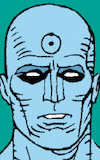
At an ABC studio, Dr. Manhattan submits uneasily to television preparation and a last-minute geopolitical briefing before an interview. Intercut with this public performance, Laurie and Dan leave the restaurant, walk past a science-fiction cinema, and—despite Dan’s earlier advice to avoid “tight corners”—enter a dark alley where Knot Tops begin to close around them.
Panels
Six panels expand and combine units of the nine-panel grid, alternating television studio and street in a controlled zigzag. The broad exterior panels let Laurie and Dan drift toward danger, while tighter studio framings crowd Manhattan; the final wide alley panel reverses that apparent openness by filling foreground and edges with approaching bodies. The next page’s simultaneous interview and confrontation makes this page a precise double setup.
Environment
The street carries a dense mixture of decay and mediated fantasy: litter, graffiti, an electric-looking vehicle, and a cinema advertising This Island Earth. Its “monsters from outer space” imagery wryly anticipates Manhattan’s televised treatment as an exotic spectacle, while the Knot Tops and neglected alley register the social disorder beneath the city’s technological modernity.
Color
John Higgins separates the parallel strands through related but distinct artificial palettes: the studio uses bright pinks, pale blues, and corporate lighting, while the street descends through olive, orange, and violet into heavy black. Manhattan’s saturated blue remains conspicuous in the studio, but outside the Knot Tops’ purple silhouettes increasingly dominate, turning “dark enough” from dialogue into compositional fact.
Symbols
The page’s strongest motif is enclosure. Manhattan is boxed in by studio personnel, cameras, makeup demands, and a political script, while Laurie and Dan move from the open sidewalk into an increasingly narrow alley. The caption advising them to avoid “tight corners” becomes a literal visual warning, linking institutional pressure and street violence as different forms of entrapment.
Themes
Both storylines concern performance under coercion. Manhattan is packaged for television while being instructed how to discuss Afghanistan; Laurie and Dan, attempting an ordinary evening, are selected by the gang as targets. Public image, political authority, and masculine aggression converge in the assumption that bodies can be managed—through cosmetics and briefing papers in one location, intimidation in the other.
Graphic Novel Technique
The page creates an ironic conversation between separate scenes: “monsters from outer space” overlays Manhattan’s alienated public status, and “try not to get into any tight corners” carries across the cut to Laurie and Dan entering one. Because comics preserve all six panels on the page at once, the reader can see the trap forming before the characters do—a sophisticated use of parallel montage and spatial foreshadowing.