Notes on this page
Chapter 2, Page 18
Summary
During the 1977 police strike, the Comedian and Nite Owl suppress rioters while debating the collapse of public order and the sanity of their fellow costumed adventurers. The Comedian answers Nite Owl’s anxious question about the American Dream with a brutal joke—he embodies it—before the scene dissolves back into Edward Blake’s funeral.
Panels
The regular nine-panel grid initially gives the riot a controlled, almost procedural rhythm: conversation alternates with gunfire, movement, and changing viewpoints while every action remains tightly boxed. Panel 7 isolates the Comedian for his punch line, granting his cynical claim the force of a direct address. In panel 8, funeral scripture enters as a caption over the fading riot memory; panel 9 completes the transition to the cemetery, where the chapter’s present quietly replaces its violent past. The page turn then expands this solemn rhythm through the following page’s repeated graveside compositions.
Environment
The half-obscured graffiti “WHO WATCHES THE WATCHMEN?” is the page’s crucial environmental detail: a political accusation painted directly behind the men who claim to protect society. Smoke, damaged streets, armed vigilantes, and hostile civilians make the city look less like a community being rescued than territory under occupation, giving the alternate America’s distrust of masks a concrete social setting.
Color
John Higgins binds the flashback with dusty pinks, oranges, and purples, colors that make smoke and street lighting feel feverish rather than naturalistic. Against that haze, the Comedian’s dark uniform forms a heavy visual anchor, while the yellow badge repeatedly catches the eye. The final panel cools toward rain-soaked blue-gray and black, converting the riot’s lurid heat into funeral austerity without entirely escaping the flashback’s purple cast.
Symbols
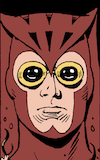
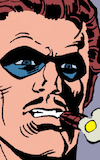
Masks dominate the page as instruments of both identity and estrangement. Nite Owl’s reflective lenses and the Comedian’s rigid face covering turn their conversation into an exchange between constructed personas; when Blake declares himself the American Dream, the mask becomes a grotesque national emblem rather than a disguise. The smiley badge remains conspicuously bright on his chest, linking this flashback to the bloodied badge that opened the book and to the badge’s descent into Blake’s grave on the following page.
Themes
The page makes the Comedian’s worldview horrifyingly clear: he treats institutional failure as proof that violence, coercion, and mockery are the nation’s true foundations. His claim to be the American Dream is bitter dramatic irony, exposing the distance between patriotic self-image and authoritarian practice. Nite Owl recognizes that something has gone wrong but remains beside him, so the scene also implicates passive decency—the failure to resist brutality can become a form of collaboration.
Graphic Novel Technique
Comics allows two times to occupy the page at once. The funeral liturgy begins before the riot flashback has visually ended, so the reader can pause over the contradiction between promises of bodily redemption and images of masked violence; Blake’s burial becomes commentary on the life being remembered. That carefully timed overlap, together with the stable grid and the next page’s continuation of the prayer, is a particularly sophisticated use of captions, gutters, and page turns for mainstream superhero comics of the period.