


Notes on this page
Chapter 2, Page 16
Summary
At Edward Blake’s rain-soaked funeral, Adrian Veidt, Dr. Manhattan, and Dan Dreiberg silently contemplate the burial. The priest’s “ashes to ashes” gives way to Dan’s memory of the Comedian suppressing riots during the police strike, shifting the page from public mourning to evidence of the brutality being mourned.
Panels
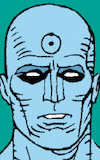
Three narrow funeral close-ups establish a slow, ceremonial rhythm, isolating Veidt, Manhattan, and Dan beneath umbrellas; the enormous fourth panel then opens abruptly into chaotic remembered action. The priest’s phrases move across the top row and complete over Dan’s face, making his close-up the hinge into the flashback. The page turn continues that memory on page 17, where the riot’s spectacle gives way to an argument about whom masked heroes actually protect.
Environment
The lower panel turns the city into a political battleground: smoke, shattered storefronts, abandoned vehicles, masked citizens, and a dense, panicked crowd surround Archie, Nite Owl’s airship. This urban wreckage makes vigilantism look less like romantic crime-fighting than improvised authoritarian crowd control amid institutional collapse.
Color
The top row is subdued by cool blue-violets, black umbrellas, rain, and restrained flesh tones; below, saturated yellow, magenta, red, and black erupt across the page. That violent palette change separates present from memory while making the riot feel feverish and morally overheated, with Archie’s yellow circles spotlighting the armed figures above the crowd.
Symbols
Circular forms dominate the flashback: Archie’s two immense windows frame Nite Owl and the Comedian like mechanical eyes, while Blake’s smiley badge sits at the center of his black costume. The badge’s promise of cheerfulness becomes grotesque beside his gun and the wounded crowd, condensing Watchmen’s recurring collision of reassuring public symbols with violence.
Themes
The page dismantles heroic nostalgia by placing funeral solemnity beside Blake’s delight in coercion. His claim that he can clear the streets turns civic disorder into permission for theatrical violence, while Nite Owl remains seated behind him, implicated by proximity and equipment. Mourning Blake therefore becomes an inquiry into whether public service can be separated from domination.
Graphic Novel Technique
Comics allows the funeral and the riot to coexist on a single page: the reader sees dignified mourners above while simultaneously confronting the conduct that complicates their grief below. The priest’s burial language functions as a verbal bridge rather than conventional narration, and the disproportionate final panel lets memory physically overwhelm the present—a particularly sophisticated use of layout, juxtaposition, and page space.