
Notes on this page
Chapter 2, Page 14
Summary
In a Saigon bar, the pregnant Vietnamese woman confronts Edward Blake as he prepares to leave, insisting that he remember her and their country. He answers with contempt; she slashes his face with a broken bottle, and the page ends with Blake aiming a gun at her while Dr. Manhattan weakly protests, turning abandonment into imminent murder.
Panels
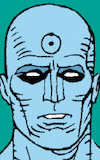
The strict nine-panel grid turns the quarrel into a tightening cinematic sequence: medium two-shots give way to the bottle strike, Blake’s bloody close-up, and finally the gun’s enormous barrel. Panel 8 places Manhattan behind the weapon as a passive witness; panel 9 reverses the view toward the woman, suspending the shot at the page turn. The following page makes that withheld instant brutally irreversible.
Environment
The prominent “Gordian Gin” advertisement makes the bar a marketplace for imported vice amid an Americanized Saigon. Blake’s announcement that he is leaving for “number ten, New York number one” places private cruelty inside the alternate history of an American victory: Vietnam is treated as a conquered pleasure ground whose people can be discarded afterward.
Color
Hot oranges, reds, magentas, and acidic yellows saturate the bar, making the scene feel feverish before violence erupts. Manhattan’s cool blue repeatedly interrupts that palette but does not calm it; his visual difference instead emphasizes his moral detachment, while the woman’s orange clothing leaves her exposed against the final panel’s black void.
Symbols
Blake’s smiley badge remains conspicuously bright while blood spreads across his face and glove, anticipating the blood-marked badge that opens the novel. The transformation is not yet complete, but the page brings the book’s central emblem of cheerful public appearance and concealed violence into close proximity with the wound that will define it.
Themes
The page stages power without responsibility. Blake treats military victory, sexual exploitation, and personal abandonment as expressions of the same entitlement, while Manhattan possesses overwhelming power yet offers only “Blake, don’t.” The woman’s attack briefly reverses their hierarchy, but Blake’s gun restores it, exposing the ugliness beneath his cynical performance of masculine control.
Graphic Novel Technique
Comics lets the reader linger over the interval between threat and consequence. The final gun-barrel composition freezes Blake’s decision while Manhattan’s two speech balloons cross panels 8 and 9, extending an inadequate objection across the gutter. That page-turn suspension makes the reader anticipate the killing before seeing it—a particularly controlled use of the nine-panel grid’s measured rhythm.