


Notes on this page
Chapter 2, Page 13
Summary
In a Saigon bar on V.V.N. Night, Dr. Manhattan listens as Edward Blake celebrates America’s victory in Vietnam with drunken, cynical jokes. As fireworks and official festivities continue outside, Blake prepares to leave the country, while a woman’s quiet “Mr. Eddie?” introduces the private consequence that will erupt on the following page.
Panels
Six panels expand and contract the scene: a broad establishing panel gives Blake’s boasts room to dominate, three middle panels tighten into conversational fragments, and the large rally image widens the historical scale before the narrow final panel returns us to personal consequence. The previous page’s firework transition carries Manhattan from Blake’s funeral into memory, while the final off-panel address creates a page-turn trap whose payoff is the confrontation on page 14.
Environment
The bar’s liquor bottles, cheap bourbon, shutters, and military clientele place imperial triumph beside tawdry routine. Outside, a helicopter, American flags, and Nixon campaign imagery turn victory into political theater: the alternate history is unmistakable, but Gibbons fills it with commercial clutter and exhausted spectators rather than heroic grandeur.
Color
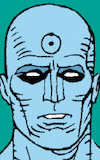
John Higgins sets Manhattan’s cool, nearly uniform blue against hot pinks, oranges, and yellows that stain Blake, the bar, and the fireworks. Manhattan remains visually detached from the feverish environment, while Blake seems absorbed into it; the black backgrounds make the celebratory bursts look less festive than incendiary.
Symbols
Blake’s smiley badge is conspicuous against his body armor, making cheerfulness a grotesque uniform for violence and nihilism. Fireworks repeatedly form circular bursts behind Manhattan, echoing both his forehead symbol and the book’s doomsday-clock imagery; celebration therefore resembles detonation, linking national victory to the apocalypse gathering beneath the novel.
Themes
Blake’s claim that America has won because its opponents surrendered treats power as the only measure of truth, while his “joke” philosophy converts atrocity into masculine bravado. The page exposes the public victory/private ruin structure of his life: imperial success and Nixonian spectacle cannot prevent the vulnerable voice in the final panel from calling him to account.
Graphic Novel Technique
The page makes history, memory, and impending violence coexist through juxtaposition rather than explanation: Blake’s dialogue runs across images of ordinary Vietnamese civilians, political spectacle, and military machinery, allowing the reader to test his cynicism against what is shown. The held final image is especially comics-specific—the eye may linger on Manhattan’s unease and Blake’s turned body before crossing the page into violence.