Notes on this page
Chapter 2, Page 10
Summary
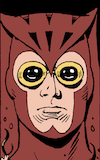
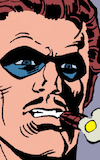
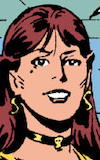
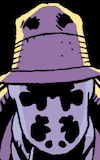
At Nelson Gardner’s Crimebusters meeting, Dr. Manhattan, Laurie Juspeczyk, Rorschach, Nite Owl, Ozymandias, Mothman, and the Comedian debate forming a new superhero organization. The Comedian seizes control of the room, ridiculing Gardner’s plan as naïve and insisting that the others cannot comprehend the crisis overtaking the world.
Panels
Seven panels loosely expand and combine units of the nine-panel grid. The opening exchanges distribute attention among the group, but the framing progressively yields to the Comedian: first his reclining legs obstruct other characters, then his boot fills the large central panel, then his standing body commands the lower-left panel, and finally his face occupies the closing close-up. This cinematic escalation converts conversational disagreement into a visual takeover. The following page briefly returns to wider group compositions, only for the Comedian to destroy Gardner’s display and leave, confirming the threat concentrated in this page’s final image.
Environment
Gardner’s display reduces social conflict to labeled problems—drugs, promiscuity, antiwar demonstrations, and racial unrest—while a newspaper identifies Dr. Manhattan as an imperialist weapon. These embedded texts expose the meeting’s political environment: masked adventurers imagine crime as manageable civic disorder even as their very presence has altered international power and intensified public anxiety.
Color
John Higgins sets the meeting against pale greens, dusty pinks, and violets, allowing the costumes to break across the room in saturated blocks. The Comedian’s black clothing and heavy shadows give him unusual visual weight amid the brighter heroes; by the final panel, purple ground, black mask, dark hair, and white cigar smoke isolate his face as the page’s harshest, most confrontational shape.
Symbols
The page’s strongest image is the Comedian’s boot planted across the tabletop display and newspaper. It turns his contempt into a physical argument: brute force dominates Gardner’s tidy diagram of society, while the paper beneath him suggests his indifference to public debate. Masks likewise function less as concealment than performance, each costume advertising a competing fantasy of authority.
Themes
The argument punctures nostalgia for organized heroism before that nostalgia can become institutional reality. Gardner and Ozymandias treat disorder as a problem that intelligence and coordination can solve; the Comedian answers with cynical realpolitik, sensing that geopolitical catastrophe exceeds the moral vocabulary of costumed crime-fighting. His warning is perceptive, but its authority rests on intimidation rather than responsibility—an essential Watchmen tension between accurate diagnosis and corrupt power.
Graphic Novel Technique
Comics lets the reader hold the whole group and the Comedian’s encroaching body in view at once: his legs, boot, standing figure, and face form a sequence of increasing graphic dominance across the page. Embedded headlines and chart labels operate simultaneously as setting and political commentary, while the page turn delays the practical consequence of his speech—his destruction of the display. This coordination of layout, scale, dialogue, and printed ephemera is a particularly sophisticated use of mainstream superhero form.