Notes on this page
Chapter 2, Page 06
Summary
In a private room after the Minutemen gathering, Sally Jupiter is changing when Edward Blake enters, propositions her, and turns violently coercive after she refuses him. The page ends as Hooded Justice arrives, shifting the balance of power but postponing the confrontation until the page turn.
Panels
Gibbons uses the regular nine-panel grid to impose a terrible, measured rhythm: conversation becomes grabbing, striking, and attempted rape through successive close views that deny the scene any heroic spectacle. The final panel withholds Hooded Justice’s full entrance, so the reader must turn the page for release; the following page then reverses Blake’s dominance and makes him the beaten figure.
Environment
The cheerful publicity gathering on the previous page gives way to a cramped backstage space littered with costumes, furniture, and the display for “Moloch’s Solar Mirror Weapon.” Superhero history becomes tawdry material culture: theatrical props and discarded clothing surround an assault, exposing the sordid private reality behind the Minutemen’s polished group image.
Color
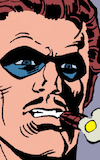
Blake’s saturated yellow costume makes him impossible to ignore against black, pink, and violet interiors; its brightness reads less as heroism than as visual intrusion. Sally’s pale skin and pink clothing remain exposed amid increasingly heavy shadows, while the cool blue floor in the final panel opens a small visual distance just as outside intervention becomes possible.
Symbols
Masks are the page’s central motif: Blake wears his throughout the assault, making the Comedian persona inseparable from his cruelty, while Hooded Justice is introduced only through a gloved hand and looming silhouette. The solar mirror’s circular surface repeatedly frames the struggle, turning a villain’s theatrical weapon into a distorted emblem of exposure and reflection.
Themes
The page destroys nostalgia for the Minutemen by showing how public heroism can shelter private abuse. Blake treats costume, celebrity, and masculine confidence as permissions, while Sally’s resistance exposes the coercion beneath his banter; Hooded Justice’s arrival offers rescue, but the wider episode complicates any simple faith that masked violence can correct masked violence.
Graphic Novel Technique
Comics makes the escalation especially disturbing because the reader can see all nine stages at once: the conversational opening, Sally’s resistance, Blake’s blows, and the rescuing hand coexist on the page as a fixed architecture of cause and consequence. Repeated framings of bodies at progressively closer range compress time while intensifying entrapment, a sophisticated use of the mainstream superhero grid against the genre’s own fantasies of power.