

Notes on this page
Chapter 1, Page 22
Summary
At the Rockefeller Military Research Center, Rorschach warns Dr. Manhattan and Laurie that someone may be eliminating former masked adventurers. Manhattan, irritated by Rorschach’s effect on Laurie, abruptly teleports him outside; deprived of control over the encounter, Rorschach finishes his warning alone and walks away muttering.
Panels
The strict nine-panel grid makes Manhattan’s exercise of power startlingly understated. Panels 4–6 form a miniature sequence of presence, absence, and displacement: Rorschach speaks before Manhattan; the next panel retains Manhattan’s head but leaves a black void where Rorschach stood; the third reveals him outside. No spectacle bridges the locations—the gutter itself performs the teleportation. The following page begins by confirming his disappearance, then slows into Laurie’s emotional aftermath.
Environment
The sterile research facility gives way to a fenced, weed-choked perimeter: Rorschach is expelled from the technological center of American power into a neglected margin. That contrast quietly locates the characters socially as well as physically—Manhattan belongs inside the state’s immense machinery, while the outlaw investigator is literally placed beyond its fence.
Color
Cool cyan and turquoise bind Manhattan to the laboratory, while Rorschach’s orange coat repeatedly pulls the eye toward the intruder. After the teleportation, the palette shifts to ochre grass, peach walls, and heavy black shadow; the warmth offers no comfort, instead making the exterior feel dry and desolate. The final silhouette reduces Rorschach’s vivid costume to near-black isolation.
Symbols
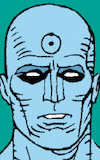
Rorschach’s mask remains the page’s governing motif. Its unstable black forms make his face both expressive and unreadable, while Manhattan’s fixed hydrogen emblem offers an opposite kind of identity: a perfectly controlled public symbol. The repeated black voids around them turn masking into a broader question of what can be seen, known, or forcibly erased.
Themes
The page stages a sharp conflict between warning and authority. Rorschach believes that persistence grants him the right to be heard; Manhattan answers not with argument but with effortless removal. The irony is severe: Rorschach may be paranoid and socially repellent, yet his suspicion is substantially correct. Institutional power dismisses an unwelcome truth because its messenger is intolerable, while Manhattan’s concern for Laurie becomes an authoritarian act committed on her behalf.
Graphic Novel Technique
The page demonstrates how comics can make an impossible event feel both instantaneous and ominously casual. Because the reader supplies continuity across the gutter, Manhattan’s intervention requires neither motion lines nor explanation: one location simply replaces another. The repeated grid also lets us compare nearly identical frames and register absence as action—a particularly sophisticated use of subtraction, rhythm, and reader inference within mainstream superhero storytelling.