

Notes on this page
Chapter 1, Page 21
Summary
In Dr. Manhattan’s government research center, Rorschach argues that Edward Blake’s murder may be part of a campaign against former costumed adventurers. Manhattan remains indifferent, while Laurie Juspeczyk’s anger rises as Rorschach insults her mother and minimizes Blake’s attempted rape; the page ends with Manhattan ordering him out.
Panels
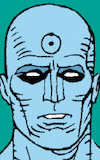
Gibbons returns to a strict nine-panel grid, turning the conversation into a sequence of measured confrontations. The upper row moves from group shot to medium shot to Manhattan’s close-up; the middle row redistributes attention among the three speakers; the final row tightens around Laurie’s accusation before ending on Manhattan’s enormous hand and profile. That closing composition converts debate into physical authority, preparing the following page’s expulsion of Rorschach.
Environment
The sterile machinery, exposed pipes, hard floors, and windowless walls make the government facility feel less like a home than a technological enclosure. Against this impersonal setting, Rorschach’s rumpled trench coat and Laurie’s ordinary clothing emphasize how thoroughly Manhattan’s superhuman body has itself become part of the state apparatus.
Color
The page’s emotional geometry is carried by sharply separated character colors: Manhattan’s cool blue, Laurie’s saturated red, and Rorschach’s brown and violet. These stable blocks let Higgins stage the argument almost abstractly—detachment, anger, and suspicion occupying the same panels—while green and purple machinery keeps the laboratory vivid but inhospitable.
Symbols
Masks organize the page’s conflict: Rorschach’s shifting inkblot hides a rigid moral identity, while Manhattan’s uncovered blue body and forehead emblem suggest perfect visibility yet profound emotional opacity. The irony is sharp—Rorschach, literally concealed, speaks from personal outrage; Manhattan, visually exposed, treats life and death as interchangeable arrangements of particles.
Themes
The page places three incompatible moral systems in collision. Manhattan’s scientific reduction of death to particle arrangement evades responsibility; Rorschach’s absolutism condemns murder while crudely dismissing sexual violence; Laurie insists that private trauma cannot be dissolved into either theory. The result is not a simple contest between feeling and reason, but an exposure of how each speaker selectively defines what deserves concern.
Graphic Novel Technique
Comics lets the reader hold all three moral positions on the page at once: Manhattan’s impassive face, Laurie’s tightening anger, and Rorschach’s masked stillness remain visually available while the dialogue advances. Repeated framings with altered scale turn an apparently static conversation into escalating pressure, and the fixed grid makes each verbal blow feel like another controlled unit—until Manhattan’s oversized final presence effectively closes the argument.