

Notes on this page
Chapter 1, Page 20
Summary
Rorschach enters the Rockefeller Military Research Center and confronts Dr. Manhattan and Laurie Juspeczyk, warning them that the Comedian has been murdered. The encounter shifts from wary comedy—Laurie challenges both his trespass and his patronizing misnaming of her—to the blunt gravity of Rorschach’s news.
Panels
The page abandons the regular nine-panel rhythm for one monumental panel occupying most of the sheet and three smaller panels stacked at right. The preceding page ends with “Good evening, Rorschach”; the target page answers across the turn with “Good evening, Dr. Manhattan,” transforming a doorway entrance into a spectacular revelation. The right-hand sequence then narrows from awe to conversation, restoring human-scale conflict before the final disclosure.
Environment
The industrial laboratory is less a superhero sanctuary than a government installation: towering machinery, armored doors, pipes, consoles, and exposed structural members surround the figures. Rorschach’s intrusion into this institutional space makes visible the political arrangement behind Manhattan’s apparent independence—superhuman power has been absorbed into the architecture of the state.
Color
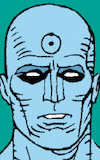
Manhattan’s pale cyan body forms the page’s largest field of color, set against black machinery and sharp yellow structural accents; Laurie’s saturated red makes her the strongest competing focal point. Rorschach’s muted purples nearly merge with the industrial shadows, so the palette visually stages three modes of presence: Manhattan as luminous phenomenon, Laurie as emotional and verbal force, and Rorschach as invasive darkness.
Symbols
Scale becomes the page’s governing motif. Manhattan’s immense, naked body dominates the composition while the masked Rorschach appears almost toy-sized near the doorway; Laurie, though physically dwarfed, controls the conversation by correcting Rorschach and demanding an answer. The contrast complicates the usual equation of size with authority: physical, social, and narrative power belong to different figures at different moments.
Themes
The page exposes the unstable relation between private identity and public power. Laurie rejects “Miss Jupiter,” a manufactured heroic name associated with her mother, while Rorschach’s wanted status collides with Manhattan’s government employment; all three are costumed identities entangled differently with institutions. The murder announcement then begins converting Rorschach’s private suspicion into the larger conspiracy that will organize the book.
Graphic Novel Technique
Comics lets the reader absorb Manhattan’s impossible scale and the dialogue simultaneously: the eye may linger over the huge left panel even as the reading order pulls toward the smaller exchanges. Gibbons uses page architecture itself as rhetoric—spectacle occupies most of the space, but crucial information arrives in compact balloons and panels. That tension between visual magnitude and conversational understatement is a particularly sophisticated manipulation of superhero iconography.