
Notes on this page
Chapter 1, Page 13
Summary
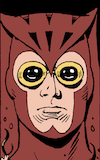
Rorschach and Dan Dreiberg end their uneasy conversation in the abandoned underground headquarters. As Rorschach walks into the tunnel, Dan recalls their former partnership, then sits alone holding the Comedian’s smiley badge while his old Nite Owl costume looms from an open locker behind him, turning reminiscence into a confrontation with his own abandoned identity.
Panels
Four narrow panels slow Rorschach’s departure into discrete stages: conversation, recollection, command, and silent recession into darkness. The large final panel then releases that compression, holding Dan and the costume together in one melancholy tableau. Rorschach’s shrinking figure makes the tunnel swallow him, while the page-turn leads from Dan’s immobilized introspection to Rorschach actively writing above the city on the following page.
Environment
The headquarters is less a heroic sanctuary than a decaying industrial crypt: stained walls, exposed pipes, bare lamps, metal railings, and institutional lockers surround the retired equipment. Its neglect gives physical form to Dan’s nostalgia; the age of costumed adventure survives here only as infrastructure, memorabilia, and dust.
Color
Muted browns, grays, and sickly industrial greens govern the upper sequence, with orange ceiling lights receding like diminishing signals into blackness. In the final panel, the costume’s deep red and yellow-lit doorway sharply interrupt Dan’s drab civilian suit. Color therefore assigns visual force to the discarded heroic identity while leaving the living man exhausted and diminished.
Symbols
The page’s strongest motif is the mask as a divided identity. Rorschach disappears wearing his face, while Dan removes his glasses and sits before the empty-eyed Nite Owl costume; the brightly lit uniform appears almost more animate than its owner. The Comedian’s small circular badge in Dan’s hand condenses another dead persona into an object, making masked history literally possessable.
Themes
The page makes nostalgia both seductive and accusatory. Dan calls the partnership “great times,” but Rorschach answers with the blunt fact that he quit; the final image exposes how heavily that judgment lands. Their opposed responses to the Keene Act clarify two damaged models of masculine identity: Rorschach cannot stop performing the vigilante self, while Dan has stopped acting but cannot relinquish it.
Graphic Novel Technique
Comics allows the reader to hold two versions of Dan in a single image: the defeated civilian in the foreground and the rigid superhero persona standing behind him. No flashback is needed; spatial juxtaposition makes memory present. The final panel’s prolonged stillness also lets us notice the costume before or after Dan, producing an interpretive simultaneity that film would have to impose through editing or camera movement.