Overview Rorschach is the book’s investigator and its most troublesome truth-teller: an outlaw vigilante whose pursuit of Edward Blake’s killer supplies narrative momentum while exposing the violence built into his idea of justice. The evidence records him in 661 panels, from the opening chapter through the final one, but ubiquity does not make him a stable moral center. His governing contradiction is that he seeks an objectively legible world through radically subjective interpretation. He reads people and streets as evidence of corruption, then acts as though his reading were judgment itself. The investigation can therefore be compelling even when the investigator is coercive, selective, or mistaken. Rorschach helps the book ask whether fidelity to truth remains ethical when it becomes inseparable from punitive certainty.
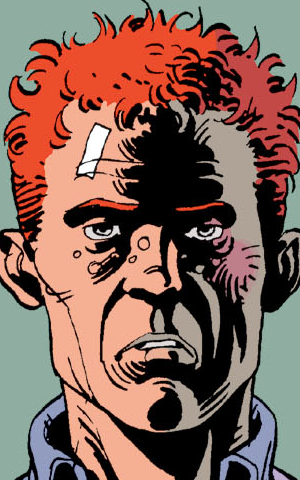
Identity The mask does not merely conceal Walter Kovacs; it becomes the identity he regards as authentic. That reversal is made brutally material during the arrest in Chapter V, page 28 : police expose his biological face, while Kovacs demands the discarded mask as though it were his actual face. The annotation’s division between hero-name and real-name panels should not automatically be treated as an exact psychological map, yet its broad pattern is revealing. Chapter I overwhelmingly presents Rorschach, whereas Chapter VI concentrates on Kovacs and his remembered transformations. On Chapter VI, page 25 , the visual echo between inkblot card and mask makes psychiatric interpretation collide with self-creation. The chapter does not uncover a civilian self safely hidden beneath the costume; it shows how little separable civilian identity remains.
Visual language Rorschach’s visual power comes from a paradox: his silhouette is immediately recognizable, but his face is perpetually unstable. The trench coat and hat give him a shabby, street-level solidity, while the symmetrical inkblots deny readers ordinary facial access. In Chapter I, page 15 , his brown figure advances through a saturated bar of oranges, reds, purples, and black; repeated framing lets him enlarge from unnoticed background presence into looming threat. The mask remains impassive while exposed faces sweat, hesitate, and register fear, so other bodies perform the emotion he withholds. Yet this apparent authority is constructed. His arrest exposes both his injured face and the elevator shoe used to increase his height, converting an intimidating graphic icon into an assemblage of vulnerable body, clothing, and theatrical devices.
Relationships Nite Owl is Rorschach’s defining relational counterweight: their 228 shared panels far exceed his totals with Ozymandias, Silk Spectre, Dr. Manhattan, or the Comedian. The statistic establishes emphasis, while the supplied scenes clarify its dramatic use. Rorschach contributes suspicion, relentless forward motion, and readiness for confrontation; Nite Owl supplies practical and technological competence. Their partnership becomes productive in Chapter X, page 20 , where Rorschach’s guess and Nite Owl’s computer work turn diffuse conspiracy into evidence. Veidt and Manhattan subsequently test different limits of Rorschach’s authority. Veidt physically displaces him with effortless control at Karnak, whereas Manhattan confronts the principle he will not surrender. These relationships progressively strip away intimidation, partnership, and force, leaving his commitment to disclosure as the final thing that defines him.
Narrative arc Rorschach’s arc changes the reader’s knowledge more than it changes his governing ethic. He dominates Chapter I, nearly disappears in Chapters III and IV, and then becomes the object of capture, exposure, and retrospective explanation. Chapter VI is his densest chapter, with 149 panels and a decisive shift toward the Kovacs annotation: the investigator who had classified everyone else is placed under institutional observation and made available for interpretation. Chapter VIII presents him entirely under the real-name key, even as Chapter VIII, page 17 shows his tactical ingenuity and lethal worldview surviving confinement intact. After his return to the mask, the late chapters restore him to the investigation but diminish his control. By Chapter XII, page 23 , narrative agency has narrowed to one choice: whether he will consent to silence. He does not.
Themes Rorschach makes moral absolutism dramatically powerful by showing both what it preserves and what it destroys. His certainty resists euphemism: Veidt’s peace remains founded on concealed mass murder, whatever its consequences. Yet the same certainty repeatedly licenses coercion and dehumanization. In the prison scene, ingenuity and cruelty are inseparable; he converts institutional fixtures into a lethal trap and treats death as a score. His journal likewise turns observation into accusation, reducing a complicated urban environment to proof of corruption in Chapter II, page 25 . The book therefore refuses to make him either a clean spokesman for truth or a disposable fanatic. Through him, truth becomes an ethical problem: accountability may require disclosure, but a person incapable of compromise may also be incapable of recognizing lives that do not fit his categories.
Select a page reference to inspect its panel layout.