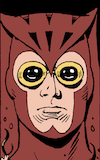
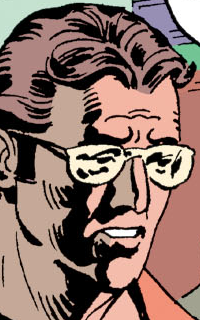
Overview Dan Dreiberg occupies Watchmen’s middle register: neither godlike nor doctrinally absolute, he is an affluent engineer whose owl-themed machines turn technical imagination into superhero performance. His organizing contradiction is that retirement appears to have restored ordinary life while actually depriving that life of vitality and coherence. The early chapters overwhelmingly present Dan rather than Nite Owl; Chapter VII, his great concentration of 171 panels, stages the renewed traffic between those identities; Chapters X and XI show only the costumed designation. Yet the mask is neither merely false nor wholly liberating. It permits courage, companionship, and action, but also reveals how thoroughly Dan has stored desire and purpose inside an obsolete heroic role. He makes superhero nostalgia emotionally attractive even as the book exposes its political and personal costs.
Identity For Dan, civilian and costumed identities conceal and sustain each other until separation becomes impracticable. In Chapter I, page 10 , doorways progressively enclose the plainly dressed retiree before Rorschach appears inside his kitchen: Dan’s supposedly private home has already been repossessed by the masked past. Later, Detective Fine reads the owl calendar and sugar cubes in Dan’s kitchen as clues, turning domestic objects into involuntary testimony in Chapter VIII, page 9 . Retirement therefore proves less an escape than a poorly maintained disguise. Conversely, Nite Owl is not simply an imposture laid over an authentic Dan; the canonical record makes his aircraft, goggles, and equipment expressions of genuine engineering fascination. The costume externalizes capacities Dan possesses, but has been unable to integrate into an ordinary adult life.
Visual language Dan’s visual vocabulary joins watching to machinery: owl imagery, goggles, aircraft, and specialized equipment replace supernatural power with designed extensions of the body. Those round lenses can suggest command of vision while denying access to his eyes, giving him technological competence at the price of emotional legibility. The silent nightmare in Chapter VII, page 16 makes that exchange explicit without reducing mask and nakedness to opposites. Glasses become the Nite Owl mask; partners and costumes change; warm flesh and russet fabric are overtaken by a nuclear flare and black skeletons. Narrow vertical panels fragment desire into transformations, while the widened bedroom panel restores material space only after catastrophe has entered it. The sequence makes Nite Owl look simultaneously empowering and fragile: armor for a body whose longings remain exposed to history.
Relationships Laurie most fully tests whether Dan can bring heroic energy into reciprocal intimacy. Their normalized 298 shared panels establish narrative emphasis, but the page evidence supplies the quality: in Chapter III, page 8 , his distracted over-pouring of sugar turns kindness into awkward excess as her distress breaches polite conversation. Their connection begins within the sealed social world that has isolated them, yet later offers a provisional human refuge from it. Rorschach, present with Dan in 228 panels, supplies the harsher counterpressure. He invades Dan’s home in costume and later becomes his investigative partner; their practical cooperation does not erase their ethical difference. Against Veidt, Dan’s technological intelligence becomes genuinely diagnostic, but the Antarctic encounter makes him physically and strategically small inside another engineer’s far more total system of control.
Narrative arc Dan’s arc is shaped less as conversion than reactivation followed by moral diminishment. Chapters I and III present him entirely under his real-name key, while the past supplies costumed fragments; Chapter VII then mixes 129 civilian and 42 heroic panels, making the return of Nite Owl a process rather than an instantaneous switch. Chapter VIII divides the identities evenly, but Chapters X and XI classify all 151 appearances as Nite Owl: once investigation accelerates, costume becomes his continuous narrative condition. That apparent restoration does not restore the simpler world he misses. In Chapter XI, page 15 , the broad ceremonial interior makes Dan and Rorschach small, hesitant figures already caught within Veidt’s field of surveillance. By Chapter XII the civilian designation returns, but survival does not resolve the compromised relation between action, knowledge, and responsibility.
Themes Dan makes nostalgia a serious ethical problem because the past he desires contains both fellowship and complicity. During the riot memory in Chapter II, page 18 , Nite Owl recognizes social collapse yet remains beside the Comedian’s coercive brutality; decent unease does not amount to resistance. The same backward pull later restores confidence and intimacy, so the book refuses the easy claim that nostalgia is merely delusion. Instead it asks what happens when a person’s best capacities are bound to an authoritarian form. Dan also humanizes the conflict between abstract schemes and embodied life. In Chapter XII, page 22 , costume removal, touch, and the couple’s broken reflection answer mass death with vulnerable attachment. That answer preserves value without mastering the political disaster surrounding it—and therefore remains moving precisely because it is insufficient.
Select a page reference to inspect its panel layout.